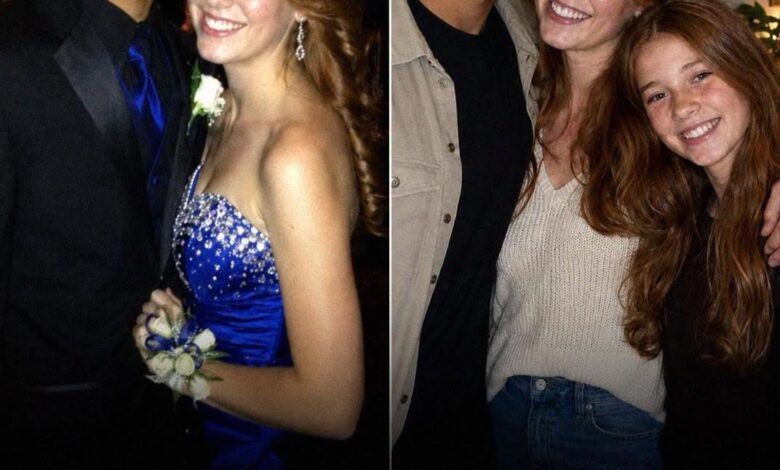
You are sitting at your high school reunion, nursing a drink, when your past suddenly walks through the door in the form of a teenage girl who looks you dead in the eye and whispers the one word that shatters your entire reality: “Dad.” You haven’t seen her mother, your high school sweetheart, in fifteen years. The glass slips from your wife’s hand, wine stains the floor like a spreading bloodbath, and your life evaporates in a single second. But this wasn’t an accident. It was a calculated, devastating trap. As you discover the agonizing truth behind her arrival, your world will never recover.
The invitation to my fifteen-year high school reunion had sat on my kitchen counter for three weeks, a taunting reminder of a past I had worked tirelessly to bury. My wife, Claire, had been the one to push me, convinced that reconnecting with old classmates would be healthy, even healing. I was hesitant, plagued by a vague sense of dread, but she insisted. She even helped me pick out a navy blazer, adjusting my collar with a reassuring smile. I let her talk me into it, never realizing that I was walking directly into a narrative that would dismantle my marriage and everything I held dear.
The old gymnasium was exactly as I remembered it—smelling of floor wax and the ghosts of adolescence. The DJ played tracks that were already fading into obscurity by the time we graduated. I spent twenty minutes shaking hands and forcing laughter at jokes I couldn’t understand, feeling like a stranger in a museum of my own history. Then, the double doors groaned open, and my high school sweetheart, Vanessa, walked in. She wasn’t alone. She was gripping the hand of a teenage girl, roughly fourteen years old, who possessed the exact, unmistakable features of the girl I had loved so long ago.
Vanessa moved through the crowd with the confidence of someone fulfilling a mission. She stopped three feet in front of me, her voice cutting through the chatter like a siren. “Everyone,” she announced to the surrounding tables, “this is Mia. Our daughter.” The girl locked eyes with me, her expression unreadable, and whispered, “Hi, Dad.” The sound of the wine glass shattering against the floor was deafening. I turned to look at Claire, but she didn’t look at me. She simply set her remaining drink on a nearby table, gathered her purse, and walked out the door, leaving me in the wreckage of a life I had spent a decade building.
The fallout was immediate and catastrophic. Vanessa stood there, tears spilling down her face, claiming she had spent fifteen years “protecting me from the truth.” I was drowning in her accusations, desperately trying to understand what she meant when she asked if my own mother had told me I “wanted nothing to do with the baby.” I stood there, stunned, as the room filled with the hushed whispers of classmates who were witnessing my life fall apart. The drive home was a blur of panic. I called Claire dozens of times, but she was gone. My mother stopped answering her phone. By the next morning, I was officially a man without a home, a marriage, or a coherent story.
A week passed in a state of sensory deprivation, defined only by the ringing of an unanswered phone. Then, the doorbell broke the silence. Vanessa stood on my porch in the pouring rain, soaked and trembling, with a suitcase at her feet and a terrified-looking Mia hovering behind her like a shadow. She claimed her landlord had changed the locks and her family had abandoned her. I should have turned them away, but the sight of Mia, staring at her wet sneakers with the hollow eyes of a child who had been rejected by the world, broke my resolve. I let them stay in my guesthouse.
For three months, I lived in a state of surreal, domestic suspension. I told myself it would be one night, then three, then a week. I watched Mia from afar, learning the small, quiet rhythms of her life—how she hummed when she read, how she scrambled her eggs, and how she thanked me twice for every small kindness. I demanded a DNA test, but Vanessa refused with a cold, desperate hardness, claiming the girl had been rejected enough. I was being tortured by the ambiguity, struggling to differentiate between a cynical con artist’s scheme and the genuine, desperate hope in a child’s eyes.
The breaking point arrived on a Tuesday evening. I was walking past the guesthouse when the wind carried a whispered conversation through the cracked window. “Mom, what if he finds out the truth?” Mia asked. Vanessa’s reply stopped my heart: “He can’t find out until the plan works. And then we win.” I stood in the wet grass, the groceries wilting at my feet, feeling the cold realization that my worst paranoia had been entirely correct. There was a plan, there was a lawyer, and I was the target.
I decided to end the charade on my own terms. The next morning, a black car pulled into my driveway, and a man in a gray suit stepped out, clutching a folder with my name printed on the front. I expected a lawsuit for child support, but as the lawyer handed me the documents, he uttered the last thing I could have predicted: “Sir, these are guardianship papers. Your daughter’s mother has asked you to be named sole legal guardian.” I looked at Vanessa, who was sitting on the porch steps, looking smaller than ever. She finally broke down, the walls of her deception crumbling in an instant.
She wasn’t trying to steal my money; she was trying to save her child. She confessed that she had terminal cancer and only months to live. She had cheated on me years ago, and when the biological father rejected Mia, she had raised her alone. Seeing the end approaching, she had orchestrated this elaborate, dishonest scheme to ensure that Mia would be safe, loved, and protected when she was gone. She chose me because I was the only decent man she had ever known. The “plan” wasn’t a heist; it was a desperate, misguided act of maternal love from a woman who had nowhere else to turn.
In the weeks that followed, the resentment I had harbored began to dissolve into a profound, aching sorrow. Vanessa entered hospice care, and the transition of guardianship moved through the courts with the help of the same lawyer I had initially feared. We didn’t magically fix the damage done to my marriage, but we began the work of saving a life. Mia, who had spent her existence feeling like an unwanted burden, finally had a home where she was valued. Sometimes, the truth is not a weapon of destruction, but a brutal, uncomfortable bridge that allows us to walk toward something—however broken—that is finally, truly real.
